If You Have Love For One Another

If You Have Love For One Another

I was in junior high school when I first remember learning of the Holocaust. I didn’t understand what it was all about at the time and I didn’t really grasp the horror of it all until some time later when I was looking at a magazine. I think it was Life Magazine. I saw several full page photos of the victims. It was shocking and made me wonder how could anyone do that to anyone, let alone to an entire group of people. So I did what a lot of us do when we see something horrible and we’re not quite ready to process it; I set it aside in the back of my mind.

Memories of the initial horror of seeing those holocaust pictures in the late 1960’s were revisited recently when I came across a New York Times article about the holocaust. As horrific as the killing of thousands of innocent Jewish people was, I was sickened to learn in this article that the Nazi’s gathered groups of disabled people and murdered them as well. This was especially hurtful to learn as I’ve long held a special place on my heart for the disabled. My dad was crippled by polio in the early 1950’s, my sweet little brother Doug, was born mentally retarded (now called mentally disabled) in 1957, our beautiful daughter Megan was born with Spina Bifida in 1986, and our sweet granddaughter Remi, was born with Down Syndrome in 2021.

The holocaust was born out of Adolf Hitler’s rise to power in Germany. He was a German political leader in the 1930’s who rose to the rank of Fuhrer in the 1940’s German Nazi party. He believed that the Jews were Germany’s enemies, and that they were an inferior race. Full of hate and racism, he sought to get rid of the Jews by killing them, and create a country full of “perfect” people of which he, of course, would be their leader. Interestingly he did all of this while claiming to be a Christian, and denouncing Christianity at the same time.

It’s also interesting how he got so many people to follow him.

Thinking about all of this made me wonder if Hitler’s hatred for the Jews may have been fueled by his misguided so-called Christian beliefs. Regardless, whatever Hitler thought and did was wrong on so many levels. His basic beliefs were skewed to say the least. I suspect if he had a Bible he didn’t read it. If he’d actually read and studied the Bible, he might have learned that the Jews weren’t responsible for Jesus’s death on the cross, but it was us; it was actually our sins that nailed Him on the cross:

He is the propitiation for our sins, and not for ours only but also for the sins of the whole world. 1 John 2:2

By canceling the record of debt that stood against us with its legal demands. This he set aside, nailing it to the cross. Colossians 2:14

Secondly, all of us are disabled in some way or another.  None of us are perfect; there is no such thing as perfect people or the the perfect race. We all have flaws and imperfections, physically, emotionally, and spiritually; including and especially sin.

Anyone who thinks they’re perfect and are constantly seeking perfection, are guilty of the sin of pride, and that’s regardless of whether they realize it or not. 

Haughty eyes and a proud heart, the unplowed field of the wicked, produce sin. Proverbs 21:4

Only God, Jesus, and the Holy Spirit are perfect, and it is not until we receive Jesus in repentance and faith does God change the way He sees us.  If Hitler had read the Bible he would known this as well:

For all have sinned and fall short of the glory of God. Romans 3:23

As for God, his way is perfect; the word of the Lord is flawless. He is a shield for all who take refuge in him. Psalm 18:30

Fortunately I’m not Hitler’s nor anyone else’s judge, but the Bible tells us that when we become a believer there should be a change in our life, in the way we think and in the things we do; life before Jesus and life after Jesus, there should be a difference. In John 13:35 Jesus tells of one distinguishing characteristic of the believer: 

“By this all people will know that you are my disciples, if you have love for one another.” 

My Creed is Jesus Christ

My Creed is Jesus Christ

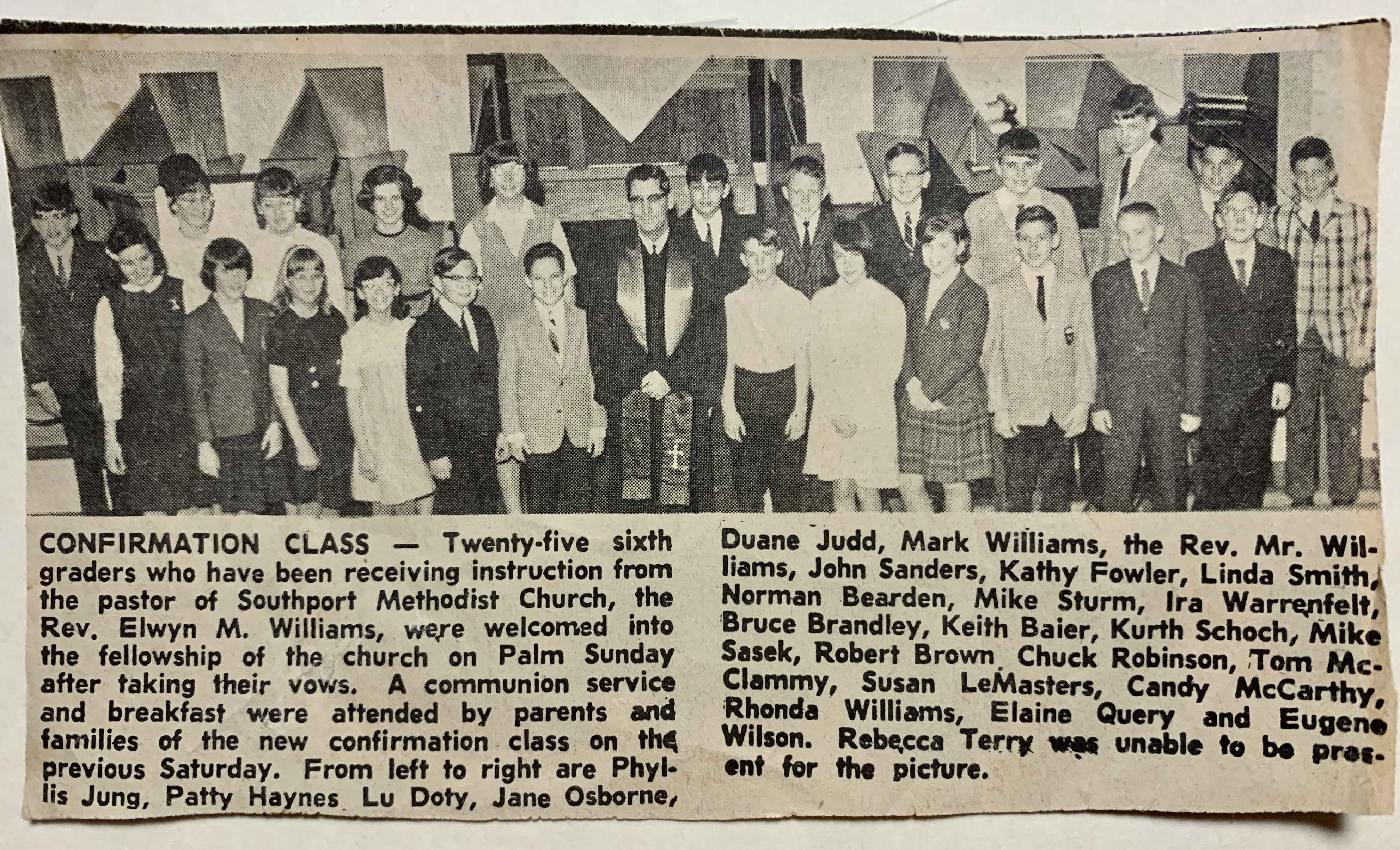
The first church I became a member of was Southport Methodist Church.

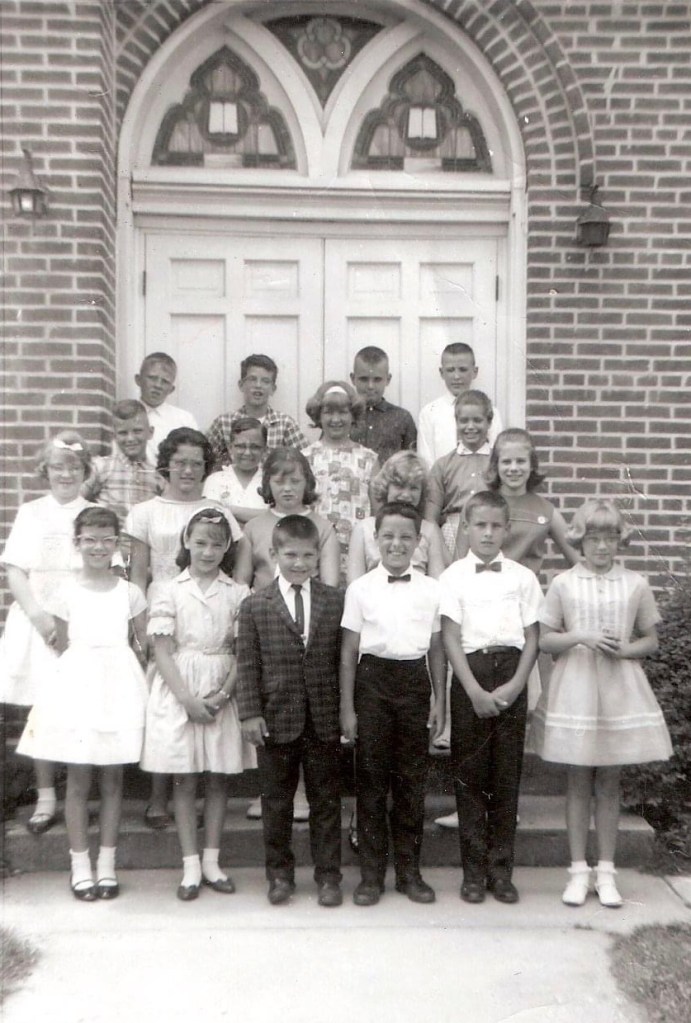
Here’s a picture of me and my 5th grade Sunday School class sometime around 1964 or 1965. I’m on the second row, second from the left. This was the church our family attended while I was growing up in Indianapolis. I have some very fond memories from when I attended this church, especially when I was young. It was here that I first trusted in Christ around the age of 12, although I don’t believe it was a saving faith.

Around 3 years after this picture was taken, the church changed their name to include “United.” I continued my membership there into my young adult years, with increasing periods of inactivity on and off during my late teens and early 20’s, and then a resurgence in my mid-twenties. God got my attention one night after listening to Billy Graham speak on TV a few nights before. I woke up in the middle of the night thinking about all the sin in my life, and I cried out to Him in repentance and faith. I believe it was at this time that I was born again, as it was from this point forward that my life began to change. I began reading my Bible and started going back to my old church. However, after a while a couple of things started bothering me. My Sunday School class studied books that seemed more philosophical than biblical, and many of the pastor’s sermons were light on Bible verses and heavy on modern day stories.

Around this same time, I was listening regularly to Charles Stanley from First Baptist Atlanta, on the radio. His sermons were jam packed with Bible verses and Bible stories. This style of preaching was new to me and I found myself very drawn to it. While I enjoyed my old church, God had different plans for me.

In 1988 I was convicted to be baptized by full water immersion at age 33. I became a member of Providence Baptist Church in Riverview, Florida. It was a series of events that lead up to both my change in church membership and in my relationship with God. I wrote about this experience in a previous chapter titled, Another Gospel. In short, God was calling me to draw closer in my relationship with Him.

Nowadays I do lean more toward Reformed (Calvinism) Theology, which makes me more of a Reformed Baptist I suppose. I respect the hero’s of the Reformation such as Martin Luther, John Calvin, and Jonathan Edwards. I like John Bunyan, a Puritan who famously wrote Pilgrim’s Progress. I also like Charles Spurgeon; I agree and appreciate his clear position on water baptism, aka believer’s baptism/credobaptism.

Spurgeon wrote, “Conscience has convinced me that it is a duty to be buried with Christ in baptism, although I am sure it constitutes no part of salvation.” In his testimony, he says, “I had no superstitious idea that baptism would save me, for I was saved” even prior to being baptized. Thus, baptism was an act of obedience for Spurgeon. He answers his own question, “Why was I thus baptized?” by saying, “because I believed it to be an ordinance of Christ, very specially joined by Him with faith in His name.” So, even though he did not believe baptism as essential for salvation, he would reject the notion that baptism is non-essential.

Though baptism did not save, it symbolized or was emblematic of salvation. Spurgeon says, “I regarded baptism as the token to the believer of cleansing, the emblem of his burial with his Lord, and the outward avowal of his new birth.” That word avowal conveys the idea of baptism as a public profession or declaration to the world that a person belongs to Christ.

Clearly, the Bible contains many verses about baptism, some of which may seem to infer that baptism is required, however based on the whole of the gospel, I too, do not believe that baptism is required in order to be saved.

“For by grace you have been saved through faith, and that not of yourselves; it is the gift of God.” Ephesians 2:8

In my own personal experience for example, I was a 33 year old adult when I was convicted that I needed to be baptized by full water immersion. I understood that baptism is a step of obedience, and an outward sign of an inward change. At age 12 I had been “sprinkled” at my old Methodist church where I first trusted Christ, however was later convicted that neither the sprinkling or my salvation at age 12 was valid. Comparing my voluntary and obedient baptism as an adult, to people who get baptized because they’re told they “have to be baptized in order to be saved,” reinforces my belief that baptism is not required for salvation.

I also agree with Charles Spurgeon’s viewpoint on baptismal regeneration, the unbiblical practice of baptizing unbelievers and infants. Charles Spurgeon emphatically stated that, “We will confront this dogma with the assertion that BAPTISM WITHOUT FAITH SAVES NO ONE.”

Over the years, I’ve read many wonderful quotes and biblical teachings from Charles Spurgeon’s writings. In fact, I’ve been using The Spurgeon Study Bible since 2019 for my personal Bible study, and have grown in my faith by using it. He is one of my favorite Reformed preachers of old. John MacArthur, Voddie Bachman, Paul Washer, Sinclair Ferguson, and Alistair Begg top my list of favorite present day Reformed preachers.

At the same time, I also like Arminian preachers such as the late Charles Stanley from First Baptist Atlanta, Ray Comfort from Living Waters, Greg Laurie from A New Beginning, the late Adrian Rogers from Love Worth Finding, and of course, the late Billy Graham, who is probably the most well known evangelist of the 20th century.

I believe God uses both Arminians and Calvinists to preach the gospel message and to teach us about the Bible. I like this quote from Arminian pastor Leonard Ravenhill,

“Think like a Calvinist, live like an Arminian.”

I also like this quote from Martyn Lloyd Jones. So,whether you lean toward Arminianism or Calvinism it is a non-essential issue.

“I am a Calvinist: I believe in election and predestination; but I would not dream of putting it under the heading of essential. I put it under the heading of non-essential…. You are not saved by your precise understanding of how this great salvation comes to you.” #MartynLloydJones

So, whether you lean toward Arminianism or Calvinism it is a non-essential issue.

Now, I do find debates between Arminianism and Calvinism interesting to a point, but it bothers me when soteriology becomes an argument between believers. Those who find themselves in frequent debates on this subject would make better use of their time by instead sharing the gospel with a lost and dying world. Our job is telling. God’s job is saving. I believe God saves, with or without our help, however what a blessing it is to be used by God to help spread the gospel.

I like the response that Charles Spurgeon once gave to someone who asked him about his theology. Though he preferred to think of himself as a “mere Christian” he also said “I am never ashamed to avow myself a Calvinist,” and “I do not hesitate to take the name of Baptist, but if I am asked what is my creed, I reply, ‘It is Jesus Christ.’”