

Here’s a picture of me and my 5th grade Sunday School class sometime around 1964 or 1965. I’m on the second row, second from the left.

And, here is a 1966 newspaper clipping of my 6th grade confirmation class. This was at Southport Methodist Church in Southport, Indiana, which was the church our family attended and of which we were members while I was growing up in Indianapolis. I have a lot of fond memories from when I attended this church, especially when I was young. It was here that I first trusted in Christ around the age of 12, although I don’t believe it was a saving faith.
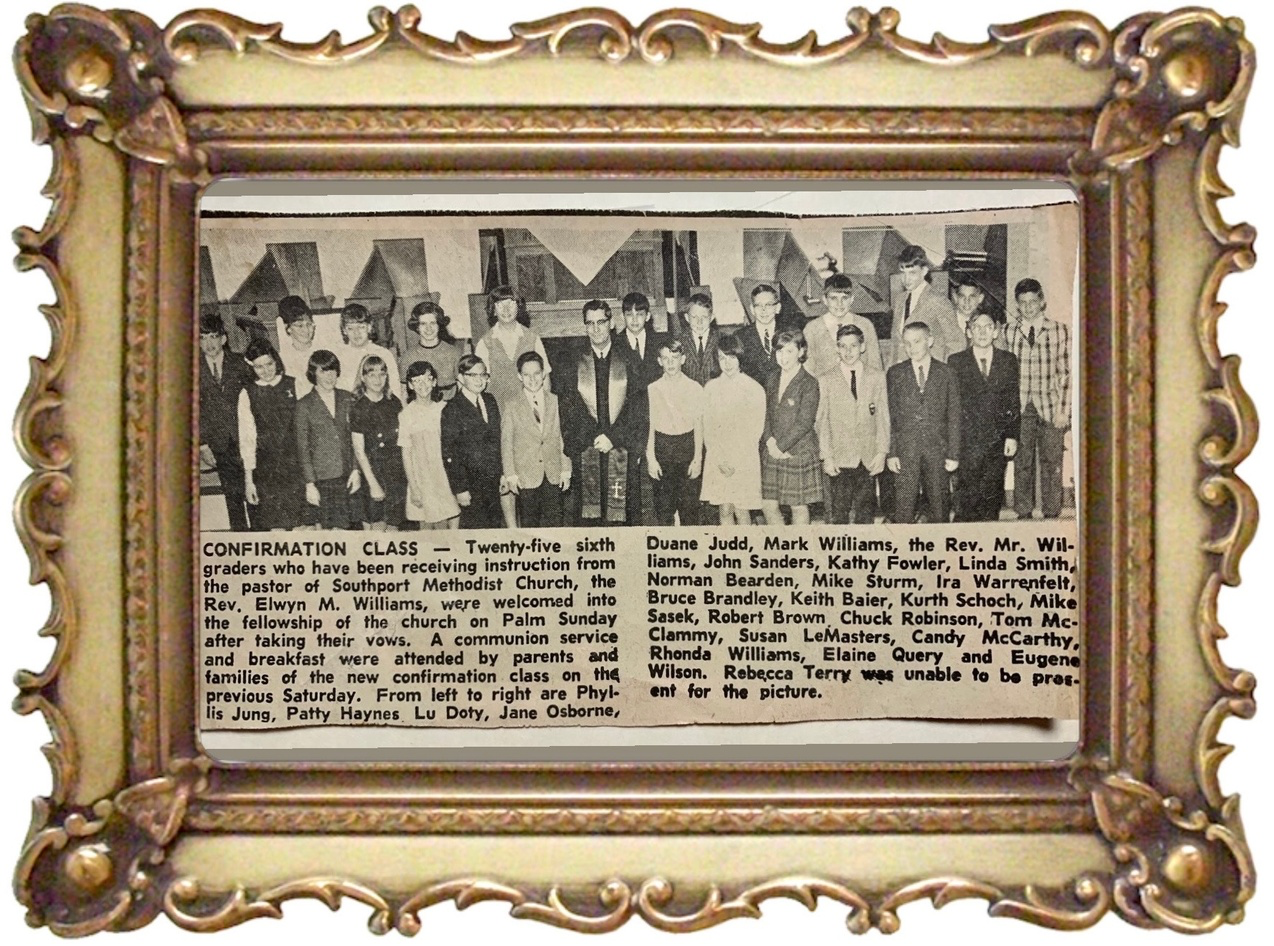
Two or three years after this photo was taken, our church changed its name to “Southport United Methodist Church.” I continued my membership there into my young adult years, with increasing periods of inactivity off-and-on during my late teens and early twenties.
Then one night in my mid twenties God got my attention after listening to Billy Graham speak on television a couple of nights earlier. I woke up in the middle of the night thinking about all the sin in my life, and I cried out to Him in repentance and faith. I believe it was at this time that I was born again, as it was from this point forward that my life began to change.
“For by grace you have been saved through faith, and that not of yourselves; it is the gift of God.” Ephesians 2:8
I began reading my Bible and started going back to my old Methodist church. However, after a while, a couple of things began to bother me. My Sunday School class studied books that seemed more philosophical than biblical, and many of the pastor’s sermons were light on Bible verses and heavy on modern-day stories.
Around this same time, I was listening regularly to Charles Stanley from First Baptist Atlanta, on the radio. His sermons were jam-packed with Bible verses and Bible stories. This style of preaching was new to me, and I found myself very drawn to it. While I liked my old church and the people, God had different plans for me.
In 1988, I was convicted to be baptized by full water immersion at age 33, and to become a member of Providence Baptist Church in Riverview, Florida. It was a series of events that led up to both my change in church membership and in my relationship with God. I wrote about this experience in a previous chapter titled “Another Gospel.” In short, God was calling me to draw closer in my relationship with Him.
Nowadays I do lean more toward Reformed or Calvinistic theology however I prefer to be known simply as a biblical Christian. I respect Martin Luther as a hero of the Reformation. I like John Bunyan, a Puritan who wrote Pilgrim’s Progress, and I like Charles Spurgeon, who was a renowned 19th-century Baptist preacher and a moderate Calvinist who affirmed the doctrines of grace.
The late Dr. John MacArthur, the late Voddie Baucham, the late R.C. Sproul, Alistair Begg, Paul Washer, and Sinclair Ferguson are some of my favorite present-day Calvinistic and/or Reformed preachers.
At the same time, I also like Arminian preachers and evangelists such as the late Dr. Charles Stanley from First Baptist Atlanta, the late Dr. Adrian Rogers from Love Worth Finding, and of course, the late Dr. Billy Graham, who is probably the most well-known evangelist of the 20th century. Now I do acknowlege there were some issues concerning Billy Graham’s ministry which I will not go into here but I do believe God used him to point many people to Christ, including me. I also like and use the evangelism tools from Ray Comfort’s Living Waters Ministries.
I believe God uses both Arminians and Calvinists to preach the gospel message and to teach us about the Bible. I appreciate this quote from Arminian pastor Leonard Ravenhill,
“Think like a Calvinist, live like an Arminian.”
I also like this quote from Martyn Lloyd-Jones: “I am a Calvinist: I believe in election and predestination; but I would not dream of putting it under the heading of essential. I put it under the heading of non-essential… You are not saved by your precise understanding of how this great salvation comes to you.”
So, whether you lean toward Arminianism or Calvinism theology, to me it’s really a non-essential issue.
I find debates between Arminianism and Calvinism interesting to a point, but I don’t like it when it turns into a soteriology or theology argument. Those who find themselves in frequent debates on this subject would make much better use of their time by sharing the gospel with a lost and dying world. Our job is telling; God’s job is saving.
I acually most prefer Christian apologist Ken Ham’s position concerning this topic. He rejects man-made theological labels like Calvinist and Arminian, preferring to describe himself simply as a biblical Christian. He states, “I’m both Calvinist and Arminian, and I’m neither Calvinist nor Arminian. When I say I’m both, it’s because, in many ways, I agree with both. When I say I’m neither, I’m saying I’m not one or the other.” He argues that man-made labels that often confuse Christians and that we have to be careful about defining things in human terms when we are dealing with a sovereign, infinite God. I agree with Ken Ham and I do appreciate his public stance on this matter.
I also like the response that Charles Spurgeon once gave to someone who asked him about his theology. Although he preferred to think of himself as a “mere Christian,” he also said, “I am never ashamed to avow myself a Calvinist,” and, “I do not hesitate to take the name of Baptist, but if I am asked what is my creed, I reply, ‘It is Jesus Christ.’”



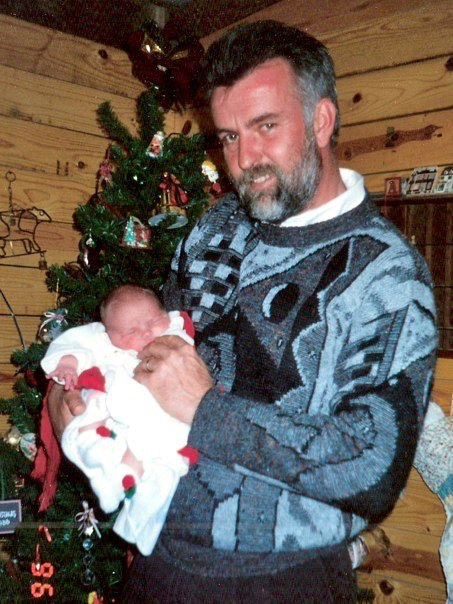 Harold and Mackenzie 👶🏻 on Christmas 🎄 Day 1996.

































 The Lord had said to Abram, “Go from your country, your people and your father’s household to the land that I will show you.” Genesis 12:1
